

Is Your Skin Losing Moisture? The Omega-7 Fatty Acid That Supports Skin Hydration
If your skin has been feeling dry, tight, sensitive, or just… missing some of its natural glow, you might immediately think:
“I need more collagen.”
Or maybe: “I need a better moisturizer.”
But what if the real issue isn’t what you’re adding?
What if it’s what your skin is losing?
Every day, your skin quietly loses moisture through a process scientists call trans epidermal water loss (TEWL), and the factor that controls that moisture loss isn’t collagen. It’s your skin barrier — and the lipids that hold it together.
One of those lipids is a lesser-known fatty acid called Omega-7, which helps support the skin’s natural moisture balance from within. To understand why Omega-7 matters, it helps to first understand how your skin barrier works.
What Is Omega-7?
Omega-7 is a monounsaturated fatty acid that helps support the body’s natural moisture balance, particularly in tissues like the skin and mucous membranes.
Also known as palmitoleic acid, Omega-7 helps support the lipid layers that allow skin to retain hydration and maintain a healthy barrier.
When consumed, Omega-7 is absorbed and delivered throughout the body, including skin cells as they form in deeper layers of the skin. This makes it a unique nutrient for supporting skin hydration from the inside out.
 What Is the Skin Barrier?
Your skin barrier is the outermost layer of your skin. Think of it as your body’s built-in shield.
It protects you from:
• Pollution
• Bacteria
• Environmental stress
• Irritants
But one of its most important jobs is keeping moisture inside your skin.
Your skin is constantly losing small amounts of water into the air. A strong barrier helps regulate that loss so skin can stay hydrated and comfortable.
What Is Trans Epidermal Water Loss?
Trans epidermal water loss (TEWL) is simply the scientific term for water evaporating from the skin. This happens naturally throughout the day, and that is normal, but when the skin barrier becomes weakened, water escapes faster than your skin can replace it. That’s when dryness, flakiness, and sensitivity start to appear. Skin may feel tight after cleansing, and makeup may cling to dry areas.
Over time, ongoing moisture loss can make skin appear older than it really is — not because collagen suddenly disappeared, but because dehydrated skin simply doesn’t look as smooth, plump, or resilient.
Why Omega-7 Matters for Skin Moisture
Picture your skin barrier like a brick wall –  The skin cells are the bricks, and the natural fats, called lipids, are the mortar holding everything together.
When the mortar is strong, moisture stays in and irritants stay out, but as lipid production declines, which naturally happens with age, that mortar weakens. Small gaps form, allowing moisture to escape more easily.
Moisturizers can help temporarily, but long-term barrier strength depends on supporting those lipids. This is where Omega-7 comes in.
Omega-7 supports the lipid layer that reinforces the skin barrier, helping strengthen the “mortar” that seals in moisture. It also acts as a signaling fat, helping skin cells maintain balance and function properly.
In simple terms, Omega-7 doesn’t just patch the wall; it helps build a stronger wall in the first place.
Why Supporting the Skin Barrier Takes Time
Your skin constantly renews itself — about every 28 days in younger adults, and more slowly as we age. That means supporting your skin barrier from within isn’t an overnight fix.
Instead, nutrients support the process gradually as new skin cells form and move to the surface, becoming part of that protective barrier.
Think of it as strengthening the structure while the wall is being rebuilt.
How to Support Your Skin Barrier from Within
If you’re focused on strengthening your skin barrier and supporting healthy hydration, nutrients that support lipid balance may be worth considering. 
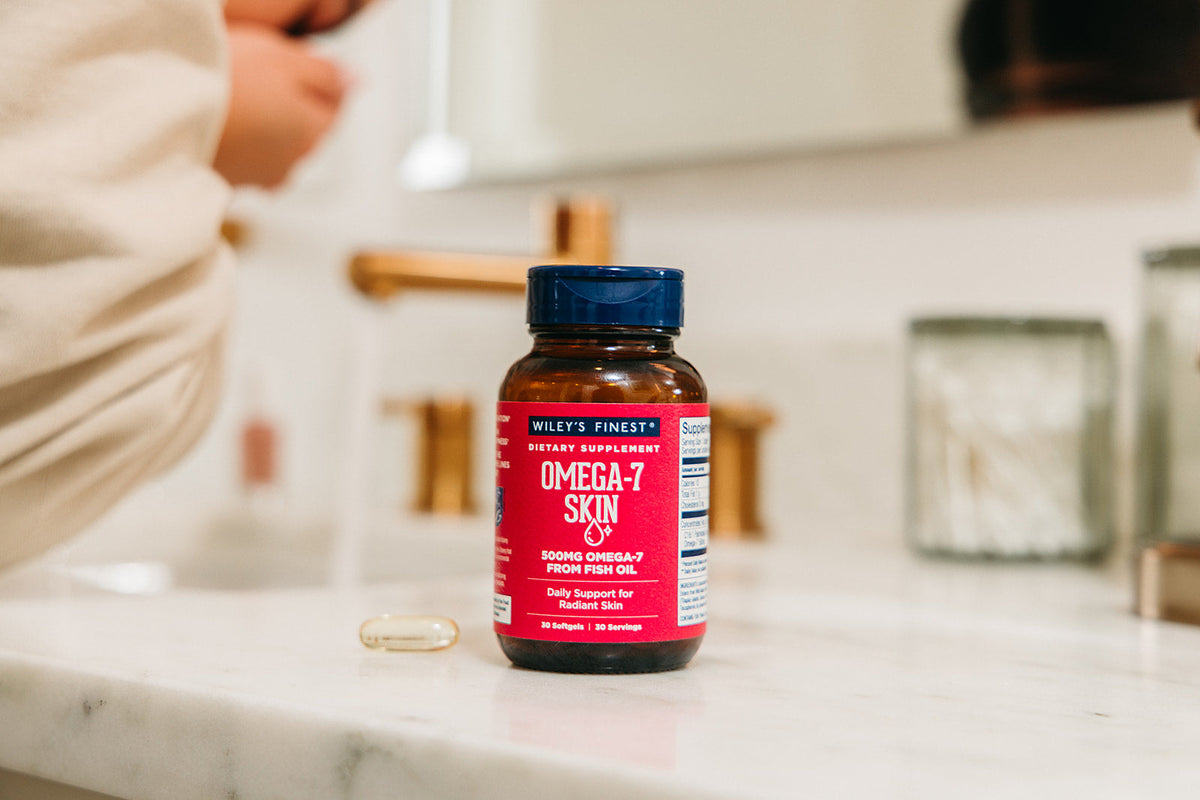
Wiley’s Finest® Omega-7 Skin provides a concentrated source of Omega-7 sourced from Wild Alaska Pollock oil, captured during the Omega-3 concentration process. Instead of discarding this naturally occurring portion of the oil, it’s carefully refined and upcycled into a targeted supplement designed to support skin hydration from within.
It’s a simple and sustainable way to support the same lipid systems your skin already relies on to maintain moisture balance.
Learn more about Omega-7 Skin and how it can fit into your daily routine.
The Real Takeaway
Healthy-looking skin isn’t just about what you put on it.
It’s about how well your skin holds onto hydration:
• A strong barrier
• Balanced lipids
• Controlled moisture loss
When those pieces work together, skin looks calmer, smoother, and more resilient.
Sometimes the goal isn’t adding more layers – it is supporting what your skin was designed to do all along.
Selected Scientific References
Koh YG, et al. Efficacy and safety of oral palmitoleic acid supplementation for skin barrier improvement: a randomized, double-blind, placebo-controlled trial. Heliyon. 2023.
Feingold KR. The outer frontier: the importance of lipid metabolism in the skin. J Lipid Res. 2009;50(Suppl):S417–S422.
Proksch E, Brandner JM, Jensen JM. The skin: an indispensable barrier. Exp Dermatol. 2008;17(12):1063–1072.
Cao H, et al. Identification of a lipokine, a lipid hormone linking adipose tissue to systemic metabolism. Cell. 2008;134(6):933–944.
Elias PM. Stratum corneum defensive functions: an integrated view. J Invest Dermatol. 2005;125(2):183–200.
Rawlings AV, Harding CR. Moisturization and skin barrier function. Dermatol Ther. 2004;17(S1):43–48.
Read more
Global Omega-3 Day raises awareness about Omega-3 EPA & DHA - the two essential fatty acids many people don’t get enough of, yet rely on every single day. In a world of ever-changing nutritio...

Not all fish oil labeled “sustainably sourced” meets the same standard. In Alaska, fisheries are managed under strict, science-based laws that protect fish populations and ensure long-term sustaina...